Orchestrating Intelligence: The Architecture of Multi-Agent Systems
Why stop at one brain? Exploring the shift from singular LLMs to collaborative multi-agent swarms. We look at orchestration patterns, shared memory, and the "herding cats" problem of AI engineering.
Beyond the Chatbot
We've spent the last few years marveling at the capabilities of singular Large Language Models. But as we push for more complex autonomous behaviors—coding, researching, planning—single models hit a ceiling. They hallucinate, they lose context, and they get stuck in loops.
The solution isn't just a bigger model. It's teams of models.
The Multi-Agent Pattern
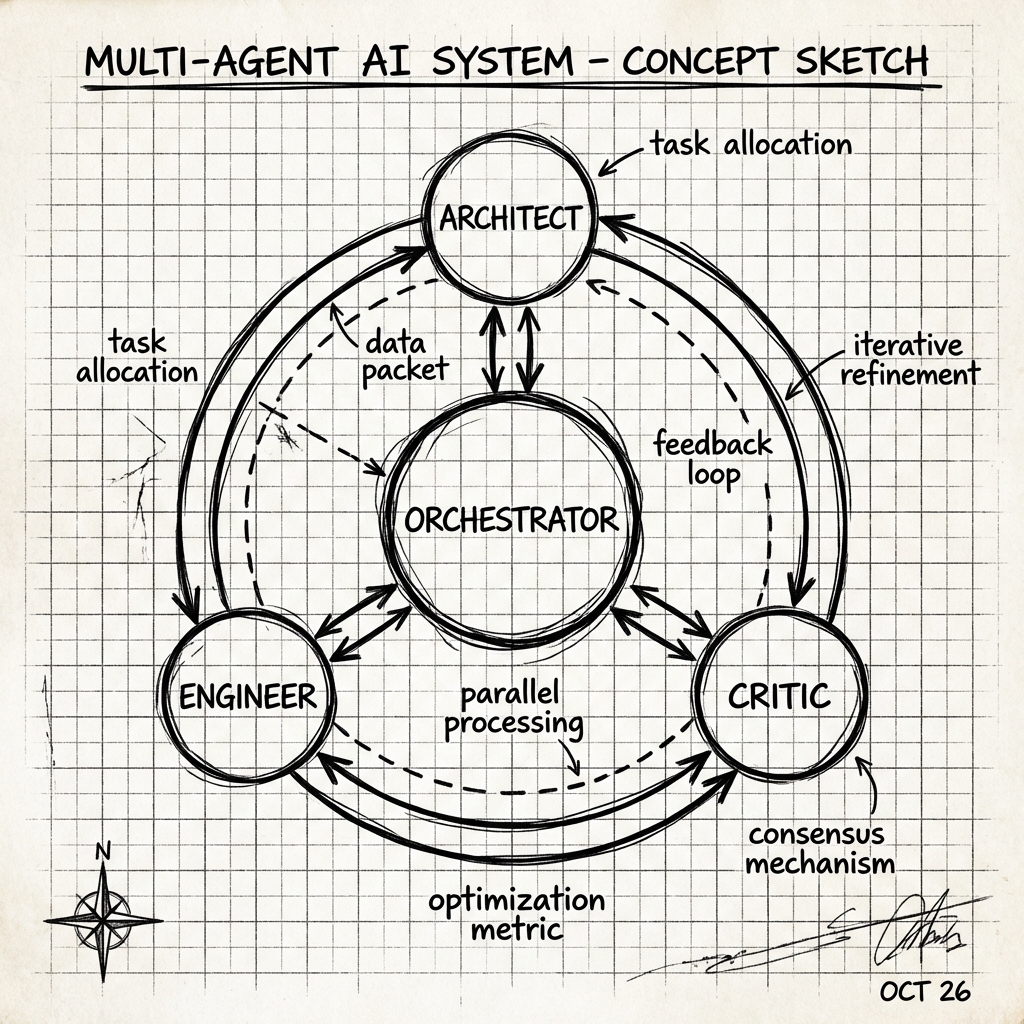
In my recent work on "Bio-Kernel" systems, I've been obsessing over Multi-Agent Architectures. The core idea is specialization. Instead of asking one generic model to "build an app," we orchestrate a swarm:
- The Architect: Plans the structure and requirements.
- The Engineer: Writes the code based on the plan.
- The Critic: Reviews the code and checks against the requirements.
- The Manager: Coordinates the hand-offs.
The "Herding Cats" Problem
It sounds elegant, but in practice, it's messy. Agents get stuck in polite loops ("No, you go first", "I agree with you"), or they diverge into chaos.
Building effective systems requires strict Orchestration Layers.
// A simplified Agent Interface
interface Agent {
  role: string;
  tools: Tool[];
  memory: VectorStore;

  think(context: string): Promise<Action>;
  act(action: Action): Promise<Result>;
}
The magic happens in the think() loop. How does an agent decide to stop planning and start acting? How does it know when to ask for help?
Systems over Frameworks
This brings me back to my core philosophy: Mathematics before Abstraction. Frameworks like LangChain or AutoGen are great, but relying on them blindly hides the complexity of state management.
To build truly robust agents, we need to treat them less like magic boxes and more like distributed systems. We need robust logging, state recovery, and deterministic control flows.
We are just scratching the surface of what collaborative AI can do.